
Rajan says, this is a time where countries should be focusing on getting the macro stability in order

Benchmark indices fell over 1 per cent each on Monday in sync with weak global markets and a sharp fall in IT stocks. The BSE benchmark Sensex tanked 861.25 points or 1.46 per cent to settle at 57,972.62. During the day, it tumbled 1,466.4 points or 2.49 per cent to 57,367.47. Similarly, the NSE Nifty fell 246 points or 1.4 per cent to 17,312.90.

'There will always be a challenge to maintain a fine balance to ensure that the growth keeps happening and inflation is contained.'

This was even as the country's economy grew by 7.3%.

Prime Minister Modi arrived in Riyadh late Monday night on a two-day visit to Saudi Arabia to participate in the high-profile financial summit Future Investment Initiative, dubbed "Davos in the desert", an initiative of Saudi Crown Prince Mohammed bin Salman.

The immediate concern for the rupee is the sharp spike in oil prices

After missing two self-imposed deadlines, billionaire Mukesh Ambani's Reliance Industries Ltd on Friday announced recalibration of a proposed $15 billion deal to sell 20 per cent stake in its oil refinery and petrochemical business to Saudi Aramco, saying the two firms have agreed to re-evaluate the proposed investment in light of the Indian firm's new energy forays. The stake sale talks, which were first officially revealed in August 2019, are being reset in light of Reliance making forays into new energy business in recent months by investing $10 billion in alternative energy over three years. To pivot to green energy, it has already bought a German maker of photovoltaic solar wafers and signed a deal with a Danish company to manufacture hydrogen electrolysers in India.

The Sensex finished above the psychologically key 60,000-mark while the Nifty surged past the 18,000-level on Monday on across-the-board buying amid a mixed trend overseas. A depreciating rupee and concerns over the US Federal Reserve hiking rates later this week failed to quell investors' appetite for stocks, traders said. The 30-share BSE Sensex rallied 786.74 points or 1.31 per cent to settle at 60,746.59.

The price of gold in India seems to have bottomed out.

The benchmark BSE Sensex and Nifty closed marginally higher in a volatile trade on Tuesday as gains in FMCG, power and energy stocks helped the indices extend gains for a fifth straight day. The 30-share BSE benchmark ended 20.86 points or 0.04 per cent higher at 58,136.36 with 16 of its constituents ending in the red. During the day, it hit a high of 58,328.41 and a low of 57,744.70.

Equity indices nursed losses for the second consecutive session on Tuesday as investors continued to dump IT, banking and FMCG stocks amid a bearish trend in global markets. Unabated foreign fund outflows and the rupee dropping to another record low against the US dollar added to the woes, traders said. Participants were also in wait-and watch mode ahead of release of retail inflation and factory output data.

Foreign investors pumped in Rs 11,119 crore in the Indian equities in December, making it the second consecutive monthly inflow, despite increasing concerns over the re-emergence of Covid-19 cases in some parts of the world. However, foreign portfolio investors (FPIs) have turned cautious in recent days. The inflow in December was much lower compared to Rs 36,239 crore invested by FPIs in the month of November, data with the depositories showed.

Prime Minister Narendra Modi on Thursday said even though India's options have increased, Russia will remain the country's "most important" defence partner as Moscow offered to fully manufacture in this country one of its most advanced helicopters.

Shaktikanta Das is a master of the finest balancing act who listens to all but takes his own decisions, discovers Tamal Bandyopadhyay.

It is going to be a long-term proposition for India -- which has a decades-old relationship with Moscow -- to reorient its foreign policy away from Russia, the US has said, insisting that re-aligning one's approach is not like flipping a light switch.

The Saudi and Iraq offer to replace Iranian crude supplies comes with a catch: Higher prices for the same quality of crude. The new government will face a tough decision over fuel price hike, says Aveek Sen.

The benchmark BSE Sensex ended down 2.23 per cent. The Bank Nifty fell 3.59 per cent.

'This is a good time to restructure your portfolio because the sectors and stocks that performed in the last bull market may not perform as much now.'

When he didn't respond (Mr Saver has lost count of how many relationship managers he has had in the past few years!), the gentleman landed up at his doorstep and started pleading with him to open fixed deposits with the bank, observes Tamal Bandyopadhyay.
Sensex, Nifty have lost about 6%, against 0.5-5% decline in other key Asian indices.

BSE Realty index zoomed by almost 7% followed by counters like Metal, Oil & Gas, Auto, Banks, Auto, Healthcare and Power, all surging between 1-5%.

Equity indices chalked up losses for the second straight session on Monday, in tandem with a bearish trend overseas as ratcheting up of hostilities in Ukraine and prospects of further rate hikes by the US Fed soured global risk sentiment. The rupee slipping to another all-time low against the US dollar amid foreign fund outflows added to the gloom, traders said. After tumbling over 800 points in intra-day trade, the 30-share BSE Sensex clawed back some lost ground to end 200.18 points or 0.34 per cent lower at 57,991.11.

Top gainers include Yes Bank, HUL, Vedanta, NTPC, Bharti Airtel, Adani Ports, PowerGrid and Tata Motors, rising up to 5 per cent.

The ethanol vehicles will have the flexibility to switch to other fuels

Investors must be cautious and follow a prudent diversification strategy to mitigate against any risks in case of any unforeseen events.

India's wholesale price-based inflation is at a 30-year high, leading to a "very alarming" situation for the country, former World Bank chief economist Kaushik Basu said on Thursday. He, however, doesn't see any risk of hyperinflation, but cautioned that if retail inflation follows wholesale prices, it might lead to "inflationary crisis". Participating in a virtual event organised by the Asia Society, India, Basu said the inflationary situation in India is at a "very risky bend".
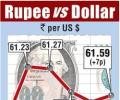
However, the hefty initial gains of the rupee, which had jumped to 61.05 intra-day, were substantially erased on month-end demand for US dollars from private oil firms and some defence-related purchases, amid fall in domestic stocks.

The panel noted that the macro-economic fundamentals of the economy are sound but challenges remain, several of which are structural in nature.

India always faces a Hobson's choice as far as feeding coal-fired generators goes - even if the government is reluctant to admit it. The country cannot do without shipping in the world's most polluting fuel from overseas. And it will continue to do so unless it decides to reduce demand by forcing citizens, farmers and businesses to live without electricity for part of the day, or use diesel generators to fire facilities.

Asian stocks sagged on Monday, with risk sentiment dampened as Shanghai shares wobbled after the Chinese markets resumed trading following a four-day long weekend.
The prospect of further falls in remittances is a hindrance for the Reserve Bank of India, as it seeks to bullet-proof the economy against sudden capital outflows

The declining exports would have implications for the job market.
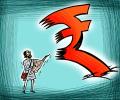
The rupee on Friday slipped 1 paisa to close at its all-time low of 78.33 (provisional) against the US dollar. At the interbank foreign exchange market, the local currency opened at 78.20 and finally settled at its all-time low of 78.33, down 1 paisa from its previous close. During the day, the local unit witnessed an intra-day high of 78.19 and a low of 78.35 against the American currency.

The dollar index eased 0.05 per cent to 98.69.

The rupee had lost 27 paise to close at more than 5-week low.

India's imports from Iran rose to 250,200 barrels per day

Among the Sensex firms, Bajaj Finance emerged as the biggest gainer by climbing 2.95 per cent. Tata Motors, Bajaj Finserv, IndusInd Bank, Sun Pharma, Mahindra & Mahindra, State Bank of India, Larsen & Toubro, HDFC, HDFC Bank, Maruti, Reliance Industries and Bharti Airtel were the other major winners. HCL Technologies, Axis Bank, ICICI Bank, Tech Mahindra and Titan were among the laggards.

On the Sensex chart, losses were mainly driven by Hero MotoCorp, Tata Motors, Axis Bank, Tata Steel, Maruti and SBI -- falling as much as 6.19 per cent.

Inflation data, both at domestic and global level, interest rate scenario in the US, geopolitical situation and general elections in 2024 are some of the major factors that would influence trading in the equity market this financial year, analysts said. Besides, foreign fund trading activity and global trends will also dictate terms in the equity market going ahead. Equity markets across the globe faced major challenges in FY23 due to concerns over high inflation, which resulted in increase in interest rates around the world, lowering investor sentiment, experts added.

'Even before the outbreak of the flu, it had become clear that the tax revenue numbers for 2019-2020 were overestimated,' observes A K Bhattacharya.
 © 2026 Rediff.com - Investor Information - Advertise with us - Disclaimer - Privacy Policy - Sitemap - Feedback - About us - Terms of use - Grievances